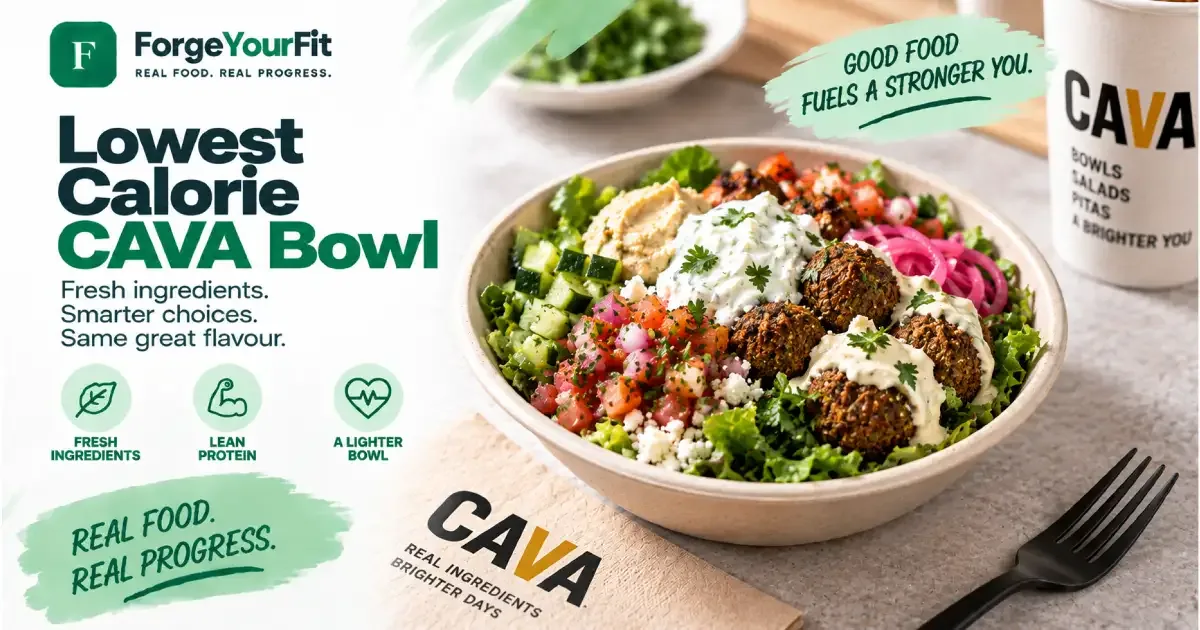
The lowest calorie Cava bowl that still delivers real protein starts at ~280 calories: SuperGreens base (15 cal) + grilled steak (160 cal) + tzatziki + eggplant dip (40 cal combined) + tomato-cucumber + pickled onions (25 cal) + yogurt dill dressing (30 cal). Swap steak for grilled chicken and it rises to ~350 cal with 33g protein — the best under-400 build for most goals.
Why Under 400 Calories Is Harder Than It Looks at Cava
Cava has built its reputation on Mediterranean food being "inherently healthy" — but that halo effect leads to real ordering mistakes. A fully loaded bowl can easily reach 900–1,000 calories before you've added a drink or side. The culprit isn't the protein or the vegetables. It's the layering of multiple high-calorie components — a grain base, two dips, a heavy dressing, avocado — each reasonable in isolation, catastrophic stacked together.
The good news: Cava's build-your-own model also gives you more calorie control than nearly any other fast-casual chain. Every ingredient is visible, priced, and nutritionally transparent. Hitting sub-400 requires discipline on four specific decision points — base, dressing, dips, and toppings — while the protein choice barely moves the needle if you pick right.
Key finding: The single biggest calorie decision at Cava isn't protein — it's the base. Choosing SuperGreens (15 cal) instead of brown rice (310 cal) saves 295 calories before a single ingredient has been added. That's more than the entire calorie contribution of a grilled chicken serving.
Based on Cava Official Nutrition Guide (2026) via forgeyourfit.com/cava-calorie-calculatorEvery Ingredient Ranked by Calories
Before building the bowls, here's the full ingredient map. These are the numbers that matter when engineering under 400 calories. Use the ForgeYourFit Cava calorie calculator to model your exact build in real time.
Bases
| Base | Calories | Protein | Carbs | Fat | Rating |
|---|---|---|---|---|---|
| SuperGreens Best | 15 | 1g | 2g | 0g | Use freely |
| Romaine | 10 | 1g | 2g | 0g | Use freely |
| Arugula | 15 | 1g | 1g | 0g | Use freely |
| Baby Spinach | 15 | 1g | 2g | 0g | Use freely |
| Black Lentils Caution | 260 | 17g | 37g | 7g | Half portion only |
| Saffron Basmati Rice Skip | 290 | 6g | 54g | 6g | Blows budget |
| Brown Basmati Rice Skip | 310 | 8g | 48g | 10g | Blows budget |
Proteins
| Protein | Calories | Protein | Fat | Notes |
|---|---|---|---|---|
| Grilled Steak Lowest Cal | 160 | 23g | 8g | Best for strict calorie control |
| Grilled Chicken | 250 | 33g | 11g | Best protein-to-calorie ratio overall |
| Harissa Honey Chicken | 260 | 30g | 12g | Slightly higher due to honey glaze |
| Grilled Meatballs | 190 | 20g | 13g | Moderate — viable if budget allows |
| Braised Lamb Skip | 280 | 19g | 23g | High fat, low protein ratio |
| Falafel Skip | 270 | 9g | 12g | Low protein for calories spent |
| Roasted Vegetables | 70 | 2g | 4g | Low protein — pair with other sources |
Dips & Spreads
| Dip / Spread | Calories | Protein | Fat | Rating |
|---|---|---|---|---|
| Eggplant & Red Pepper Dip Best | 15 | 0g | 1g | Almost calorie-free, great flavor |
| Tzatziki | 25 | 1g | 2g | Excellent value, creamy texture |
| Hummus | 30 | 1g | 2g | Good — keep to one scoop |
| Red Pepper Hummus | 25 | 1g | 2g | Slightly sweeter, same calorie level |
| Harissa | 60–70 | 1g | 6g | Use sparingly if cutting calories |
| Crazy Feta® Limit | ~80–100 | 2g | 8g | Creamy, but calorie-dense |
Dressings
| Dressing | Calories | Protein | Fat | Rating |
|---|---|---|---|---|
| Yogurt Dill Lowest Cal | 30 | 2g | 2g | Best option — light and flavorful |
| Balsamic Date Vinaigrette | 60 | 0g | 4g | Good second choice |
| Lemon Herb Tahini | 70 | 2g | 6g | Viable — adds nutty depth |
| Hot Harissa Vinaigrette | 70 | 0g | 7g | Manageable if you want heat |
| Tahini Caesar | 90 | 2g | 8g | Moderate — use with greens |
| Skhug | 80–90 | 0g | 9g | Spicy, oily — limit |
| Greek Vinaigrette Skip | 130 | 0g | 14g | Kills sub-400 budget fast |
| Garlic Dressing Skip | 180 | 0g | 20g | The biggest calorie dressing on the menu |
Source: Cava Official Nutrition Guide and ForgeYourFit Cava Calorie Calculator. Values as of 2026; minor variances by location possible.
Build your exact Cava bowl and see the calories live
Every ingredient, every calorie — modeled in real time before you order.
3 Proven Builds Under 400 Calories
These aren't theoretical — they're constructed ingredient-by-ingredient using verified 2026 Cava nutrition data. Each solves for a different priority: absolute minimum calories, best protein-to-calorie ratio, and best flavor within the budget.
- SuperGreens base15 cal
- Grilled steak (protein)160 cal
- Tzatziki (dip)25 cal
- Eggplant & red pepper dip15 cal
- Tomato + cucumber (topping)5 cal
- Pickled onions (topping)20 cal
- Yogurt dill dressing30 cal
- Total~270–280 cal
Best for: strict calorie deficit, low-carb eating, anyone who wants maximum room left in their daily budget. Steak's 23g protein is solid for the calories spent. The bowl is lighter on volume — add extra romaine and more free-calorie veggies if you want it more filling.
- SuperGreens base15 cal
- Grilled chicken (protein)250 cal
- Tzatziki (dip)25 cal
- Eggplant & red pepper dip15 cal
- Tomato + cucumber (topping)5 cal
- Pickled onions (topping)20 cal
- Yogurt dill dressing30 cal
- Total~360 cal
Best for: weight loss while preserving muscle, post-workout refueling, anyone tracking macros seriously. Grilled chicken's 33g protein is the highest at Cava per serving. Add crumbled feta (+35 cal) if you have the budget — it adds flavor and 3g extra protein.
- SuperGreens + Romaine mix~20 cal
- Grilled chicken (protein)250 cal
- Tzatziki (dip)25 cal
- Hummus (dip)30 cal
- Tomato + cucumber (topping)5 cal
- Pickled onions (topping)20 cal
- Crumbled feta (topping)35 cal
- Yogurt dill dressing30 cal
- Total~415 cal
Swap the feta (35 cal) for a squeeze of lemon to bring this under 380 calories. The feta + hummus + tzatziki trio is classically Mediterranean and keeps the bowl interesting without relying on high-calorie dressings. This is the build most people will actually enjoy eating regularly.
Key finding: Grilled chicken at Cava delivers 33g of protein at 250 calories — a protein density of approximately 132g per 1,000 calories. That's higher than falafel (33g protein per 1,000 cal) and significantly more than braised lamb (68g protein per 1,000 cal). For anyone trying to stay lean while hitting protein targets, chicken is the decisive choice.
Calculated from Cava Official Nutrition Guide (2026)The Four Decisions That Determine Your Bowl's Calorie Count
You don't need to memorize every ingredient number. Cava bowls are controlled by four decisions, in order of calorie impact:
1. Base: Greens vs. Grains (up to 310 cal difference)
This is the most consequential decision you make at Cava. Any grain base — rice or lentils — adds 260–310 calories before you've added anything else. For a sub-400 bowl, greens-only is non-negotiable. SuperGreens, romaine, arugula, and baby spinach all come in at 10–15 calories each. You can combine two greens for more volume without spending a single meaningful calorie.
If you genuinely want some grain texture, ask for a half portion of black lentils (~130 calories). Lentils also add around 8–9g of protein and significant fiber — making them the only grain worth the calorie cost at this budget.
2. Dressing: The Invisible Calorie Bomb (30–180 cal range)
Dressings are where most Cava calorie estimates go wrong. People mentally budget for the protein and base, then add a dressing as an afterthought — without realizing garlic dressing alone adds 180 calories, or Greek vinaigrette adds 130. Yogurt dill at 30 calories is your default. It's creamy, herby, and pairs with virtually any bowl combination. Balsamic date vinaigrette (60 cal) is the right choice if you want something sweeter.
Common mistake: Ordering Greek vinaigrette because it "sounds light." At 130 calories and 14g fat, it adds more calories than the entire vegetable topping section of a typical bowl. Yogurt dill (30 cal) has the same cooling, creamy quality at one-quarter of the calorie cost.
3. Dips & Spreads: Stack Two Low-Cal Options (15–100 cal each)
Cava lets you pick multiple dips, and this is actually one of the best things about the build-your-own model for low-calorie eating. The eggplant and red pepper dip is 15 calories. Tzatziki is 25. Hummus is 30. Choosing two of these three gives you genuine Mediterranean flavor at 40–55 total calories — less than one tablespoon of most restaurant dressings.
Avoid Crazy Feta as your primary spread if you're tight on calories. It's delicious but closer to 80–100 calories per serving, and its richness can make it feel like more of the meal than it is.
4. Toppings: Load Up — Most Are Near Zero Calories
Tomato + cucumber: 5 calories. Pickled onions: 20 calories. Salt-brined pickles: 5 calories. Sumac slaw: 30 calories. Fire-roasted corn: 45 calories. The vegetable toppings at Cava are so low in calories that stacking them freely is both the smart and satisfying move. The only toppings to watch are avocado (160 cal), pita crisps (270 cal), and to a lesser extent, crumbled feta (35 cal). Skip the first two entirely for a sub-400 build.
Verify your exact bowl before you order
Use the ForgeYourFit Cava calculator to model any combination in real time — no guessing.
Can You Add a Grain and Stay Under 400? The Math
Technically, yes — with significant tradeoffs. Black lentils at a half portion (~130 cal) combined with Build 1's steak-based bowl (~280 cal) gets you to approximately 410 calories. You'd need to remove one dip (save 25 cal) to edge under 400 — landing at about 385 calories with 17g extra protein from the lentils. That's a genuinely strong nutritional profile: ~42g total protein, high fiber, under 400 calories.
Full portions of any grain base make sub-400 mathematically impossible once you add a real protein. A full brown rice base (310 cal) + grilled steak (160 cal) alone is already 470 calories before dips, toppings, or dressing. Keep that in mind when the person ahead of you in line makes it look easy to get the rice bowl.
What About Vegan or Vegetarian Builds Under 400?
This is harder but possible. Falafel (270 cal) as your primary protein leaves only ~130 calories for everything else — barely enough for dips and dressing. Roasted vegetables (70 cal) as protein is very low-calorie but delivers only 2g protein, making it inadequate as a standalone protein source.
The most practical plant-based sub-400 build: SuperGreens base (15 cal) + roasted vegetables (70 cal) + hummus (30 cal) + eggplant dip (15 cal) + tomato-cucumber (5 cal) + pickled onions (20 cal) + lemon herb tahini (70 cal) = approximately 225 calories. Add a half portion of black lentils (~130 cal) to bring protein up and you're at ~355 calories with around 20–22g plant protein. That's a real, filling plant-based meal within the budget.
What to Read Next
If you're using Cava strategically for your nutrition goals, these guides are worth your time. The Chipotle 150g protein guide applies the same ingredient-level thinking to Chipotle bowls, and the restaurant nutrition calculators hub covers Qdoba, Dunkin, and more. For tracking your daily targets, the fitness calculators section includes calorie and macro tools that pair directly with restaurant eating.
Source: Cava Official Nutrition & Allergen Guide. Ingredient-level calorie data as of 2026.
Source: ForgeYourFit Cava Calorie Calculator. Nutrition data sourced from Cava's official 2026 nutrition guide.
Source: Stokes T, et al. Recent perspectives on the role of dietary protein for the promotion of muscle hypertrophy. Nutrients, 2018. For protein target context.