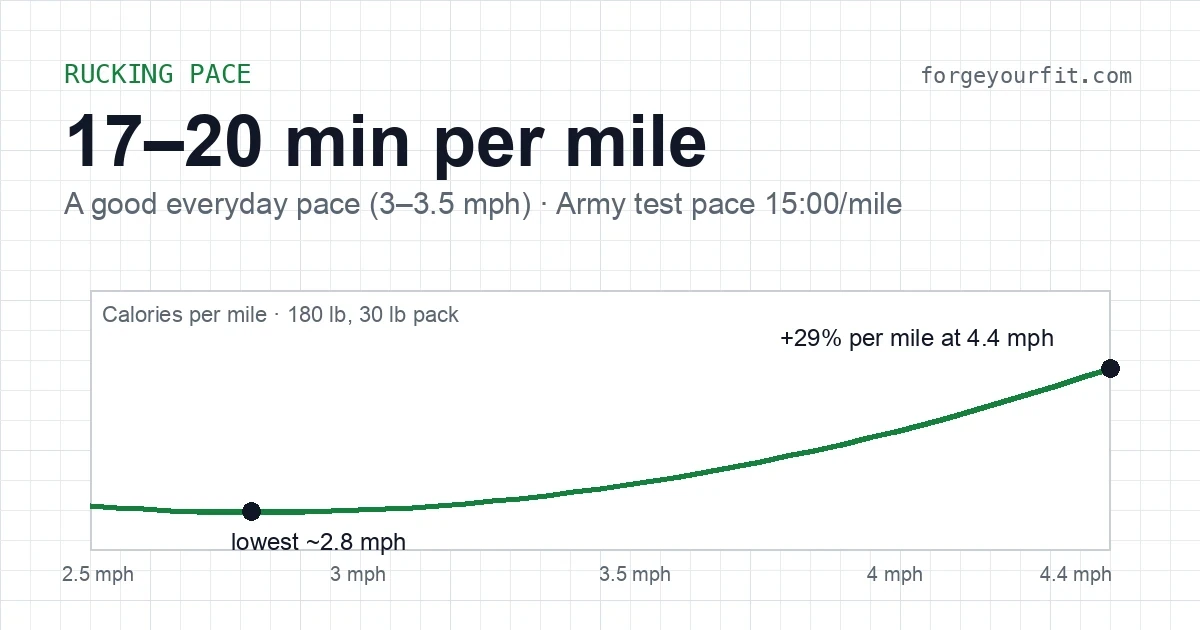
A good rucking pace for most people is about 17 to 20 minutes per mile, or 3 to 3.5 mph. That is close to normal walking speed, and a moderate pack barely changes it. A pace of 15 minutes per mile (4 mph) is the US Army's 12-mile test standard: a strong, test-level pace rather than an everyday training speed.
If you are new to rucking, start with the complete beginner's guide to rucking, then use the pace chart below.
Key takeaways
- A good everyday rucking pace is about 17 to 20 minutes per mile (3 to 3.5 mph); people choose about 3 mph when they walk, with or without a moderate pack.
- The Army's Expert Infantryman Badge test asks for 12 miles in 3 hours with a 35 lb ruck, which is exactly 15:00 per mile (4 mph).
- A pack up to 20% of bodyweight did not change people's chosen walking speed in a 2022 study; at 40% they walked about 3% slower.
- Above about 2.8 mph, faster rucking burns more per mile as well as per hour: by the US Army LCDA equation, about 16% more per mile at 4 mph than at the lowest point.
- The LCDA model estimates that on a 5% hill, the same effort as 3.5 mph on flat ground means about 23:32 per mile (2.55 mph).
What is a good rucking pace?
A good rucking pace is the one you can hold for your whole route while standing tall and breathing steadily. A sensible target is 17 to 20 minutes per mile (3 to 3.5 mph), with 15 minutes per mile (4 mph) as a strong, test-level pace.
The reason the range starts near 3 mph is that this is how fast people walk. In a 2022 study of 30 adults walking overground at their own chosen speed, average speed was 4.7 to 4.8 km/h, roughly 3 mph (Middleton et al., 2022). A meta-analysis of 23,111 healthy adults found normal walking speeds topping out at about 1.43 m/s (3.2 mph) for men in their 40s and falling with age to about 0.94 m/s (2.1 mph) for women over 80 (Bohannon and Williams Andrews, 2011). Rucking starts from that baseline and adds a pack.
Rucking pace chart: minutes per mile, mph and calories
Use this chart to convert between minutes per mile, mph and minutes per kilometer. The calorie column is for a 180 lb person carrying a 30 lb pack on flat ground.
| Pace (min/mile) | Speed (mph) | Pace (min/km) | What it feels like | Calories per hour (180 lb, 30 lb pack) |
|---|---|---|---|---|
| 24:00 | 2.5 | 14:55 | Easy stroll | ~288 |
| 20:00 | 3.0 | 12:26 | Natural walking pace | ~343 |
| 17:09 | 3.5 | 10:39 | Brisk, still conversational | ~420 |
| 15:00 | 4.0 | 9:19 | Army 12-mile test pace | ~530 |
| 13:38 | 4.4 | 8:28 | Very fast march | ~647 |
| 13:20 | 4.5 | 8:17 | Close to breaking into a jog | not modeled |
Calories come from the US Army LCDA load-carriage equation (Looney et al., 2022), the same equation as our rucking calorie calculator. The figures assume flat, paved ground and count resting metabolism as 1 MET, as the calculator does. The equation was tested up to 1.97 m/s (4.4 mph), so the chart gives no calorie figure at 4.5 mph. For other bodyweights and pack weights, see the rucking calories burned chart.
What pace is the Army ruck march standard?
The best-known Army benchmark is 15:00 per mile. To earn the Expert Infantryman Badge, soldiers "must complete a 12-mile foot march in three hours or less, wearing a 35-pound ruck sack" (US Army, 2016). Twelve miles in 180 minutes is 15 minutes per mile, or 4 mph.
That is a test pace, not the Army's everyday marching speed. The Army's 1990 field manual on foot marches, FM 21-18 (since replaced by ATP 3-21.18), describes a normal foot march day as 8 hours covering 32 km "at a rate of 4 kph", about 2.5 mph, and that rate includes rest halts (FM 21-18, 1990). Soldiers who march all day move much slower than a 12-mile test pace, and for good reason: a pace you can hold for 8 hours is not the pace you can hold for 3.
Moving pace vs elapsed pace
Moving pace counts only the time you are actually walking. Elapsed pace counts everything from start to finish, including stops for water, traffic lights and pack adjustments. Watches and apps often report both, and the gap can be large.
The Army manual shows how large. FM 21-18 schedules a 15-minute halt after the first 45 minutes of marching and then a 10-minute halt every 50 minutes. With about 50 minutes of walking in each hour, the manual's 4 km/h elapsed rate works out to roughly 4.8 km/h while moving, about 3 mph. Same march, two honest numbers: 2.5 mph elapsed, 3 mph moving.
For calories, use moving pace and moving time. The calorie equation describes the energy cost of walking with a load; while you stand still, you burn close to your resting rate. Entering elapsed time at moving pace overstates the distance, and entering a slow elapsed pace for the full time understates the effort. If you track progress week to week, compare like with like: moving pace against moving pace.
Does a heavier pack slow you down?
Not much, up to a moderate load. In the 2022 overground study, participants carried nothing, 20% of their body mass and 40% of their body mass, and chose their own speed each time. Speed was the same with no pack and with the 20% pack, and dropped by about 0.15 km/h, roughly 3%, with the 40% pack (Middleton et al., 2022).
Where a pack does change things is at the top end. Unloaded, people switch from walking to running at about 2.06 m/s, or 4.6 mph, on average (Hreljac, 1993). A 2022 study of military personnel found that this walk-to-run transition speed fell as the carried load increased (Gill et al., 2022). So the faster you try to march with a heavy pack, the sooner walking starts to feel harder than jogging. That is why 4.5 mph with a pack sits so close to the "ruck shuffle", and why pack weight matters most if your goal is a fast time. If you are still choosing a load, the pack weight guide by level covers where to start.
Does rucking faster burn more calories?
Yes per hour, and also per mile once you go faster than about 2.8 mph. That means a faster ruck is not just the same work done sooner.
In practice, if you want more calories from the same route, walking faster works, and so does adding hills or load. If you want the most miles for the least fatigue, a natural walking pace near 3 mph is the efficient choice, which fits with people choosing about 3 mph on their own. For a side-by-side with an unloaded walk at the same speeds, see how rucking compares with walking.
Get your calorie burn at any pace
Enter your bodyweight, pack weight, distance and pace for a personalized estimate.
How much do hills slow your pace?
A lot, if you keep the effort the same. Using the same LCDA equation, we solved for the speed that costs a 180 lb person with a 30 lb pack the same calories per hour on a hill as 3.5 mph does on flat ground:
| Grade | Same-effort pace | Speed |
|---|---|---|
| Flat | 17:09 per mile | 3.5 mph |
| 3% | about 20:13 per mile | about 3.0 mph |
| 5% | about 23:32 per mile | about 2.55 mph |
| 8% | about 30:32 per mile | about 2.0 mph |
These are model estimates for steady climbing, not measured times, and real trails add footing and stops. The useful lesson holds anyway: on hilly routes, judge your effort by breathing and posture rather than by your watch, and expect your average pace to drop by several minutes per mile.
How to ruck faster
Most people get faster by building the pace gradually on a load they already handle well. These habits help:
- Raise your step rate before your stride length. Try quicker, shorter steps and keep your torso upright rather than reaching for longer strides under the pack.
- Build distance before pace. Get comfortable at your target distance first, then pick up the speed.
- Change one thing at a time. Don't add weight, distance and speed in the same week. Our pack weight guide explains when to increase load.
- Use the right number. Track moving pace on the same route so weather, stops and route changes do not hide real progress.
For what rucking trains beyond pace and calories, see the rucking benefits guide.
The bottom line
Aim for 17 to 20 minutes per mile when you start, treat 15:00 per mile as a strong test-level pace, and judge hills by effort rather than by the clock. Use moving pace when you log calories or track progress. To see what your pace means in calories, use the rucking calorie calculator.
How we calculate: ForgeYourFit's rucking calorie method is described on our About page, and the people behind the site are on the team page. Spotted an error? Contact us.
Source: Middleton K, Vickery-Howe D, Dascombe B, et al. Mechanical differences between men and women during overground load carriage at self-selected walking speeds. International Journal of Environmental Research and Public Health. 2022;19(7):3927.
Source: Bohannon RW, Williams Andrews A. Normal walking speed: a descriptive meta-analysis. Physiotherapy. 2011;97(3):182–189.
Source: US Army. Soldiers to earn the arduous Expert Infantryman Badge. 11 May 2016.
Source: Headquarters, Department of the Army. FM 21-18: Foot Marches. 1 June 1990 (superseded by ATP 3-21.18).
Source: Hreljac A. Preferred and energetically optimal gait transition speeds in human locomotion. Medicine and Science in Sports and Exercise. 1993;25(10):1158–1162.
Source: Gill N, O'Leary T, Roberts A, et al. Stature and load affect the walk to run transition speed. ISBS Proceedings Archive. 2022;40(1):57.
Source: Looney DP, Lavoie EM, Vangala SV, et al. Modeling the metabolic costs of heavy military backpacking. Medicine and Science in Sports and Exercise. 2022;54(4):646–654.