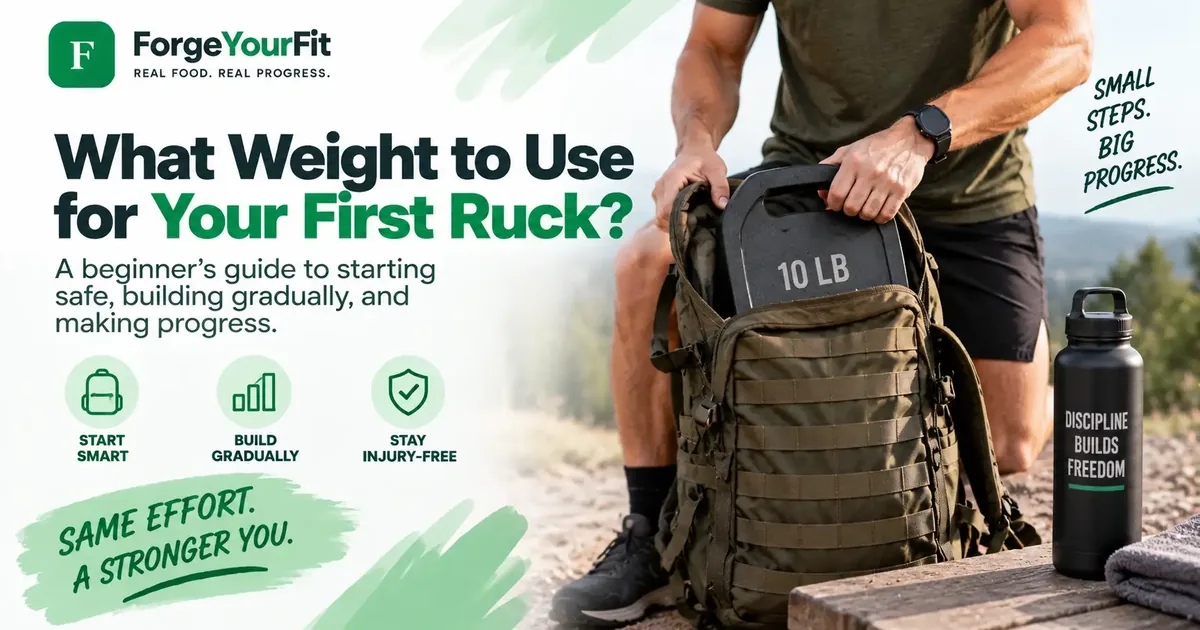
Beginners should start rucking with 10–20 lbs, targeting roughly 10% of your body weight. A 160 lb person starts at 16 lbs; a 200 lb person at 20 lbs. Body weight, fitness level, and pack fit all affect your ideal starting load — heavier is never better on day one.
Why Getting Your Starting Weight Right Actually Matters
Most beginners make one of two mistakes: they go too light and don't get any training stimulus, or — far more commonly — they go too heavy and blow up their knees, hips, or lower back within the first two weeks.
Rucking is deceptively demanding. What feels manageable at mile one can become painful by mile three, especially when joints and connective tissue haven't adapted to loaded movement. Getting the starting weight right protects you from overuse injuries and sets you up for consistent progression.
If you're new to the sport, start with our complete beginner's guide to rucking before choosing your load. Understanding the mechanics helps you make a smarter weight decision.
The 10% Rule — Your Baseline Formula
The most reliable starting point for new ruckers is 10% of your body weight. This isn't arbitrary — it's the threshold where the cardiovascular and strength demand exceeds walking, without placing excessive compressive load on unprepared joints.
Here's how the math works:
- 150 lb person → start at 15 lbs
- 175 lb person → start at 17–18 lbs
- 200 lb person → start at 20 lbs
Cap your beginner starting weight at 20 lbs regardless of body weight. Even a 250 lb athlete who is otherwise fit should not exceed 20 lbs until completing at least 4 consecutive weeks of rucking at a lower load.
Complete Starting Weight Table by Body Weight
| Body Weight | Day 1 Load | Week 4 Target | 3-Month Goal | Notes |
|---|---|---|---|---|
| Under 130 lbs | 10 lbs | 15 lbs | 20 lbs | Use lighter pack; load distribution critical |
| 130–160 lbs | 10–15 lbs | 15–20 lbs | 20–25 lbs | Standard beginner range |
| 160–200 lbs | 15–20 lbs | 20–25 lbs | 30–35 lbs | Most common range; 20 lbs = GORUCK standard |
| 200–240 lbs | 20 lbs | 25–30 lbs | 35–45 lbs | Cap Day 1 at 20 lbs regardless |
| 240+ lbs | 20 lbs | 30 lbs | 45 lbs | Prioritize distance before weight |
Want to see how your exact load affects calorie burn? Our rucking calorie calculator lets you plug in your exact weight, pack weight, distance, and pace to get a precise burn estimate.
What Factors Change Your Ideal Starting Weight
1. Your Current Fitness Level
If you can walk 3–4 miles comfortably at a 3.5 mph pace without stopping, you can start at the higher end of the 10% range. If you're sedentary or returning from a long training break, start at the lower end and add distance before weight.
2. Your Pack Quality
A properly fitted rucksack with a frame sheet and padded hip belt transfers load to the hips and away from the spine. A flimsy daypack does the opposite — all weight falls on the shoulders and compresses the lumbar spine. With a low-quality pack, reduce your starting weight by 20–25%.
3. Terrain
Flat pavement is the easiest surface for a first ruck. Hills, trails, and sand multiply effective load difficulty significantly. If your first ruck involves elevation gain, reduce weight by 5 lbs compared to what you'd carry on flat ground.
4. Distance vs. Weight
Two variables determine ruck difficulty: load and distance. Beginners should keep one fixed while building the other. The recommended approach is to fix weight first, build distance to 3–4 miles, then start adding weight. Don't try to increase both at once.
How to Load a Rucksack Correctly
Where the weight sits in your pack is nearly as important as how much weight you carry. Poor load placement shifts your center of gravity backward, forcing you to lean forward — straining the lower back and slowing pace.
- Pack weight high and close to your back — ideally between shoulder blade height and the top of the hips
- Heavier items (weight plates, water, bricks) against the back panel; lighter items toward the exterior
- No loose load — everything should be snug and immobile inside the pack
- Adjust sternum strap and hip belt so the pack doesn't sway laterally when you walk
- Leave 2 inches of clearance below the pack bottom from your hips — don't ride too low
For a full breakdown of how rucking compares to other cardio in calorie burn, read our rucking vs. running calorie comparison.
How to Progress Your Ruck Weight Safely
Once you've established a base, weight progression follows a simple rule: add no more than 5 lbs every 2–3 weeks, and only after meeting these three criteria:
- Completed your target distance (3–4 miles) at 3–3.5 mph with no pain
- No joint pain during or 24 hours after the ruck
- Completed at least 6 ruck sessions at the current weight
A typical 12-week beginner progression looks like this:
| Weeks | Load | Distance | Frequency | Focus |
|---|---|---|---|---|
| 1–2 | 10–15 lbs | 1.5–2 miles | 2x/week | Form, pack fit, pace |
| 3–4 | 10–15 lbs | 2–3 miles | 2–3x/week | Build distance |
| 5–6 | 15–20 lbs | 3 miles | 3x/week | First weight increase |
| 7–8 | 20 lbs | 3–4 miles | 3x/week | Consolidate at 20 lbs |
| 9–10 | 20–25 lbs | 4 miles | 3x/week | Push distance before weight |
| 11–12 | 25–30 lbs | 4–5 miles | 3x/week | Approach GORUCK event standard |
To understand more about what rucking at different loads does to your body, our rucking benefits deep-dive covers the muscle activation, calorie burn, and cardiovascular adaptations in detail.
What to Use as Weight (If You Don't Have a Ruck Plate)
You don't need to buy a dedicated ruck plate to start. Here are the most practical DIY weight options ranked by effectiveness:
- Books — Dense, free, and easy to stack to a target weight. Wrap in a plastic bag to protect your pack liner
- Filled water jugs — 1 liter = 2.2 lbs; easy to adjust weight and double as hydration
- Sandbag — Inexpensive, adjustable, and the most common DIY option. Use a zip-lock or dry bag liner
- Cast iron plates — From any gym or big box store. Flat 10 lb plates sit flush against a frame sheet
- Dedicated ruck plate — The cleanest option if you're committing to rucking long-term. GORUCK and Rogue both make plates sized for rucksack frame sheets
Warning Signs You're Carrying Too Much Weight
Your body gives clear signals when the load exceeds your current capacity. Stop and reduce weight if you experience any of these during or after a ruck:
- Sharp or persistent lower back pain (not general fatigue)
- Knee pain, particularly medial knee pain or pain on descents
- Hip flexor tightness or pain at the front of the hip
- Foot or heel pain (early sign of plantar fasciitis)
- Excessive forward lean — your torso tilting more than 10–15° forward
- Shoulder numbness or tingling (pack pinching the brachial plexus)
These aren't signs of weakness — they're information. Drop 5 lbs and reassess after 2 more sessions. For a detailed look at how much weight ruckers carry at intermediate and advanced levels, see our guide on how much weight to carry rucking.
The Bottom Line
Start at 10% of your body weight, cap Day 1 at 20 lbs, and add 5 lbs every 2–3 weeks only after meeting the three progression criteria above. Distance comes before weight — build to 3–4 miles before you think about loading heavier.
The goal of your first ruck isn't to impress anyone. It's to complete it without pain, understand how your body responds to loaded walking, and come back for session two. Consistent, progressive training beats heavy and inconsistent every time.
Calculate your exact rucking calorie burn
Enter your body weight, pack weight, pace, and distance to get a precise calorie estimate for any ruck.
Source: GORUCK. Standard event ruck weight guidelines and progression recommendations.
Source: US Army Field Manual FM 21-18 — Foot Marches. Official military load-bearing standards and progression protocols for sustained rucking.
Source: PubMed / NCBI. Research on metabolic cost of loaded walking and compressive joint load as a function of carried weight.